|
|
|
Stainless steel filter cloth specifications
are precise geometrical structures with uniform porosity, in contrast to
fibrous felts or synthetic fibers.
|
|
Filter cloth is used for
separation of solids and clear liquid filtration as in the cleaning of fuels or hydraulic
liquids, or in water treatment.
|
|
Stainless Steel Filter Cloth is produced in the following weave styles: |
| |
|
Twill Dutch Weaves
The finest particle size
retention possible in wire cloth is achieved by utilizing Twill Dutch Weaves. The term
"Twill" indicates the warp and shute (weft) wires pass alternately over two and
under two wires. The term "Dutch" refers to the use of a heavier warp wire
diameter in conjunction with a lighter shute wire diameter. |
|
 |
|
In a Twill Dutch Double Weave
the shute wires are driven up so tightly that there is always a shute wire above and below
the warp wires, creating a weave with the warp wires completely covered. The flow-pass
geometry is extremely tortuous, insuring excellent particle size retention.
|
|
Twill
Dutch Weave Specifications |
|
TDW Flow Rate
Data |
| |
Plain
Dutch Weaves
Plain Dutch (Hollander)
Weaves can accommodate high flow rates with a relatively low pressure
drop.
|
| |
 |
|
The
wires are woven with each
warp and weft (shute) wire passing over and under one wire. The
weft wires are smaller in
diameter than the warp wires and are driven up close together, creating a dense weave. |
| Plain
Dutch Weave Specifications |
|
PDW Flow Rate
Data |
| |
|
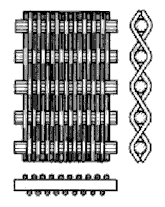
Reverse
Dutch Weaves
are woven in a reverse of
the Plain Dutch Weave wire arrangement, whereby finer warp wires
are positioned tightly together and a thicker weft wire is woven in at
set intervals.. |
|
 |
|
The
cloth is mechanically strong with a high throughput and it
performs particularly well in high pressure vertical and
horizontal applications where backwashing and filter cake
removal are important. |
|
Reverse
Dutch Weave Specifications |
|
This Section Is Under Construction
|
|
| |
ABSOLUTE MICRON RETENTION
|
|
In both types of Dutch Weave
the sum derived from multiplying the number of weft wires in a given measurement by their
diameter results in theory, on a specification with no open space. Because the wires
are driven together during the weaving process, the aperture size cannot be calculated in
the normal manner.
|
| |
|
There are two methods by which
the aperture (pore) size can be determined:
|
|
|
|
BUBBLE POINT TEST
|
|
The pressure required to pass
air bubbles through the mesh (covered by a test liquid) is measured. The average
aperture size is then calculated by taking into account surface tension, liquid density,
temperature and immersion depth. |
|
|
|
GLASS BEAD TEST |
|
A suspension containing glass
beads is passed through the mesh - the diameter of the largest bead passing through is
considered as the absolute micron retention. |
| |
|
| |
|
|
| |
|
[Technical Reference
Index]
[Woven Wire
Main Index]
[Wire
Cloth Products] |
| |
|
Screen Technology Group, Inc |
|
33008 NE Washougal River Road, Washougal
WA 98671 USA |
| |
|
Screen Technology Group,
established in 1988 With our success built on
providing a level of customer service that is
second to none, competent technical assistance,
quality materials at competitive prices,
properly packaging all orders to prevent
damage in handling and shipping promptly
according to schedule. |
| |
|
By using this website, you are agreeing that you
have read and accepted the
Terms of Use Agreement |
|
Copyright © 2015
Screen Technology Group, Inc.
All Rights Reserved.
|
Last modified:
June 06, 2017 |
|
