 |
|
|
|
|
 |
|
Common Wire Cloth Weave Styles |
|
800.440.6374 Phone 360.835.7507 sales@wovenwire.com |
| |
 |
|
Plain Weave
This is the most commonly used weave. Each weft
wire passes alternately over and under each warp wire and each warp wire passes
alternately over and under each weft wire. Warp and weft wire diameters are generally the
same. |
| |
|
|
 |
|
Twill Weave
Each weft wire alternately passes over two, then
under two successive warp wires and each warp wire passes alternately over two and under
two successive weft wires, in a staggered arrangement. Twill weave is normally used to
allow a heavier than standard wire diameter in association with a given mesh.
|
| |
|
|
 |
|
Hollander (Dutch) Weave
While the warp wires remain straight, the weft
wires are plain woven to lie as close as possible against each other in a linen weave
forming a dense strong material with small, irregular and twisting passageways that appear
triangular when diagonally viewing the weave. |
| |
|
|
 |
|
Hollander Twill Weave
Similar to Plain Hollander weave, except that the
weave is twilled, allowing a double layer of weft wires. There are no apertures in the
true sense of the word as the filtrate follows a sinuous path through the depth of the
wire cloth.
|
| |
|
|
 |
|
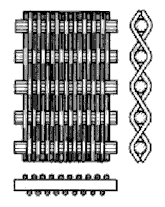
Reverse Hollander Weave
This is the reverse of the Plain Hollander (Dutch)
weave, in that the weft wires are heavier than the warp wires.
|
| |
|
|
|
|
|
|
Click Here For Pre-Crimped Weaves
|
|
|
|
[Technical
Reference
Index]
[Woven Wire
Main Index]
[Wire
Mesh Products] |
| |
|
Screen Technology Group, Inc |
|
33008 NE Washougal River Road, Washougal
WA 98671 USA |
| |
|
Screen Technology Group,
established in 1988 With our success built on
providing a level of customer service that is
second to none, competent technical assistance,
quality materials at competitive prices,
properly package every order, always ship promptly
according to schedule. |
| |
|
By using this website, you are agreeing that you
have read and accepted the
Terms of Use Agreement |
|
Copyright © 2015
Screen Technology Group, Inc.
All Rights Reserved.
|
Last modified:
August 28, 2016 |
|
|
|
|
|
|
|
|